
Picking the right food delivery app comes down to how fast cash reaches your account and how steady your week stays.
Recent data shows Uber Eats ahead on hourly pay, while DoorDash often delivers higher weekly and monthly gross across many markets.
Run both apps to capture peak windows, then prioritize the one offering stronger pricing in your zone to raise your effective rate. Expect clear comparisons, payout formulas, incentives, requirements, and scheduling tactics that strengthen your take-home.
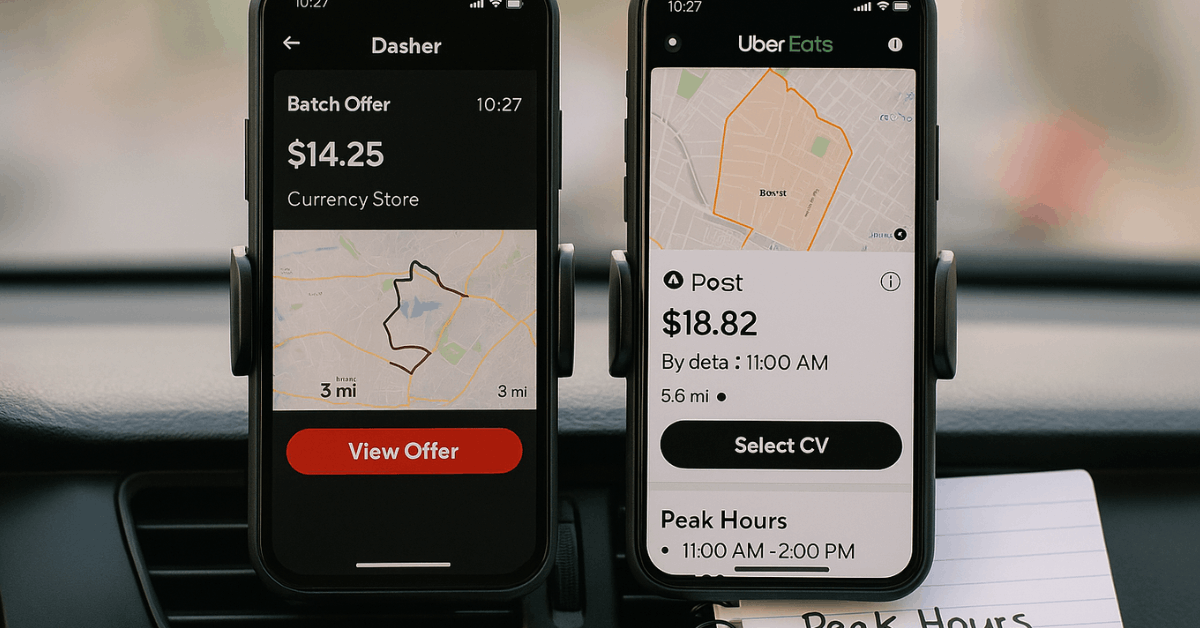
DoorDash vs Uber Eats: The Short Answer
Most drivers care about two things: hourly take-home and total weekly stability. Based on recent data, Uber Eats leads on hourly pay, while DoorDash typically wins on weekly and monthly gross in many markets.
Running both apps usually maximizes earnings, since each platform spikes at different times.
Why Food Delivery Is Booming
Analysts project food delivery to grow about 12.33% annually, potentially reaching $1.45 trillion globally by 2027.
Consumer adoption keeps rising, aided by ghost kitchens and better logistics, which lifts order volume and creates steady demand for drivers across large and mid-sized cities.
Hourly Earnings: Side-by-Side
Busy schedules favor high hourly totals, and current figures show a clear lead for Uber Eats on per-hour averages.
| Metric | DoorDash | Uber Eats |
| Hourly Gross | $13.03 | $17.72 |
| Hourly Bonus/Tips | $5.90 | $6.96 |
| Total Hourly Pay | $18.93 | $24.68 |
Daily Earnings: Workday Patterns
Shifts differ by market, but a comparison of typical daily results highlights how each app delivers value across a normal day.
| Metric | DoorDash | Uber Eats |
| Daily Gross | $63.66 | $52.94 |
| Daily Before Tips | $32.14 | $27.75 |
| Per-Task Average | $8.49 | $10.00 |
Weekly and Monthly Gross: Stability vs Flexibility
Drivers targeting reliable totals often favor DoorDash for longer horizons. Weekly gross averages around $232.35 on DoorDash versus $170.44 on Uber Eats, while monthly gross averages about $719.91 for DoorDash versus $479.95 for Uber Eats.
Markets vary, yet those numbers point to steadier earnings on DoorDash when hours are consistent.
Incentives and Bonuses
Peak windows and promotions move the needle, so planning around them matters.DoorDash challenges and goal-based bonuses reward hitting delivery targets during set periods.
Top Dasher status improves scheduling priority and access to peak times in crowded zones. Average add-ons for DoorDash total about $114.84/week and $356.33/month in bonuses and tips.
Uber Eats surge pricing lifts fares dynamically during high demand, especially in dense urban cores.
Uber Eats Boost guarantees elevated pay at specific places and times, adding about $84.70/week and $238.57/month on average.
Driver Requirements
Signing up should match your vehicle, age, and experience, since eligibility rules differ slightly.
Uber Eats
Applicants generally must be at least 19, hold a valid driver’s license, maintain insurance, and have at least one year of driving experience.
Vehicle requirements typically include two or four doors and model year limits that exclude older cars. Bike delivery can be allowed at 18 in some regions, subject to valid identification and local rules.
DoorDash
Most regions allow applicants starting at 18, though certain locations require 21 or older. Background checks screen for recent serious violations, and eligibility to work, plus proof of license and insurance, are required.
Vehicle rules are flexible, and some markets run online orientation while others use brief in-person sessions.
Pay Models
Understanding how each payout is calculated helps you target the right trips and hours.
Uber Eats Pay Formula
Earnings combine a base fare, trip supplements for distance or difficulty, promotions such as surge or Boost, and customer tips kept in full. Strategic timing around surges usually raises the effective hourly rate.
DoorDash Pay Formula
Payments include base pay typically ranging from $2–$10, promotions such as Peak Pay and challenges, and tips kept in full.
Selected markets test Earn by Time, which pays a fixed hourly rate while allowing limited declines per hour, offering a steadier floor when demand dips.
Deliveries and Scheduling
Order flow and shift control affect acceptance strategy and total output. Order cards display minimum pay, distance, pickup location, and item count, allowing informed acceptance.
No minimum acceptance rate applies to either app, enabling selective declines to protect hourly averages. In-app navigation guides pickups and drop-offs, including photo confirmation for contactless handoffs.
DoorDash enables scheduled Dashes and “Dash Now” when zones are busy, improving access during peak times. Uber Eats allows users to go online at any time, although competition can be higher during peak periods.
Getting Paid and Support
Cash flow and problem resolution policies can influence satisfaction during busy weeks.
Payout Timing and Fees
DoorDash pays weekly via direct deposit for Monday–Sunday deliveries, and Fast Pay enables instant cash-out for a $1.99 fee. Uber Eats pays weekly as well, while Instant Pay offers faster withdrawals for $0.50 per cash-out.
Support and Deactivation
Both platforms provide in-app and phone support for order issues, missing items, or unreachable customers. Policy violations can trigger deactivation, yet routine disputes or cancellations handled within rules rarely cause account loss.
Market Availability
Geography shapes demand and app choice. DoorDash operates in North America, Australia, Japan, and New Zealand, with the strongest penetration in the United States and Canada.
Uber Eats spans 6,000+ cities across 45+ countries, often making it the default option outside North America.
What Drivers Report in the Field
Driver communities frequently note that Uber Eats brings stronger order volume in many dense urban cores, while DoorDash can post higher surge or challenge pay on certain days.
Stacked orders appear frequently on Uber Eats in some markets, though both apps offer multi-order runs that lift hourly efficiency.
Pros and Cons at a Glance
Balancing strengths and trade-offs helps lock in a starting point that fits your goals.
DoorDash: Strengths and Trade-Offs
Higher weekly and monthly averages appeal to drivers seeking steadier totals, and scheduling tools reduce idle time in busy markets.
Requirements are flexible for vehicles and modes, yet availability is narrower internationally, and Fast Pay carries a higher fee than Uber’s instant option.
Uber Eats: Strengths and Trade-Offs
Hourly pay trends higher in many datasets, and global coverage expands opportunities when traveling or relocating.
Instant Pay is cheaper per withdrawal, yet driver and vehicle criteria can be stricter in some regions, and certain U.S. suburbs report lower order density than DoorDash during off-peak windows.
Expenses and Tools to Maximize Earnings
Controlling costs protects margins, while tracking data sharpens your strategy.
- Fuel, maintenance, depreciation, and occasional tolls or tickets reduce take-home if not managed.
- Mileage tracking apps such as Everlance help document deductions where eligible under local tax rules.
- Gas savings and rewards apps like Upside or Pogo can offset fuel spend during long shifts.
- Bike or scooter delivery lowers operating costs in dense areas, provided safe routes and storage are available.
- Multi-app tracking tools such as Gridwise centralize earnings, expenses, and time-of-day performance to pinpoint profitable hours.
Conclusion
Hourly maximization tends to favor Uber Eats, while longer-horizon stability frequently tilts toward DoorDash.
Markets differ widely, so the practical approach involves running both apps, favoring the one surging at that moment, and switching when demand shifts.
Consistent acceptance discipline, peak-hour focus, and cost control will raise your effective hourly rate on either platform.