
Flexible income that fits a changing schedule stays within reach through Walmart’s Spark Driver Program.
As an independent contractor, you use your own vehicle and the Spark Driver app to accept local Walmart delivery offers, earn per order plus tips, and choose hours and order types that align with your availability and targets.
What Is the Walmart Spark Driver Program?
Gig work should be flexible while still paying reliably, and Spark aims to hit both targets. The program connects local orders from Walmart to independent contractors who pick up and deliver using their own vehicles.
How It Works
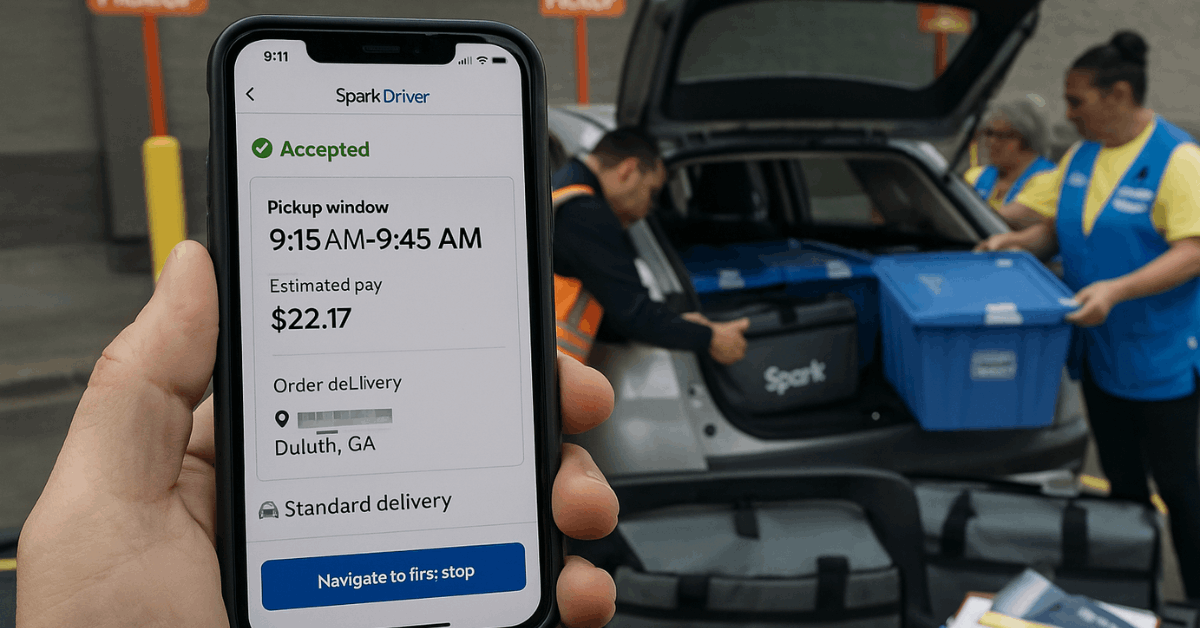
Orders are placed online or in the Walmart app and appear as offers in the Spark Driver app.
After accepting an offer, a driver heads to the assigned store, completes pickup per instructions, and delivers to the customer’s location, including contactless drop-off when requested.
What You deliver
Groceries, household items, and general merchandise make up most trips. Order types vary by store and time of day, which affects time on task and pay.
The 4 Spark Delivery Types
Busy hours and order mix change quickly, so knowing each format helps set expectations.
- Curbside pickup handoff: Customers meet inside the Walmart parking lot’s loading area. Drivers hand over packaged orders without traveling to homes, keeping trip time short and predictable.
- Express deliveries: Stores target rapid turnaround, commonly within about an hour of order creation. Drivers typically spend fifteen to twenty-five minutes per run, which can support steady incentives during peaks.
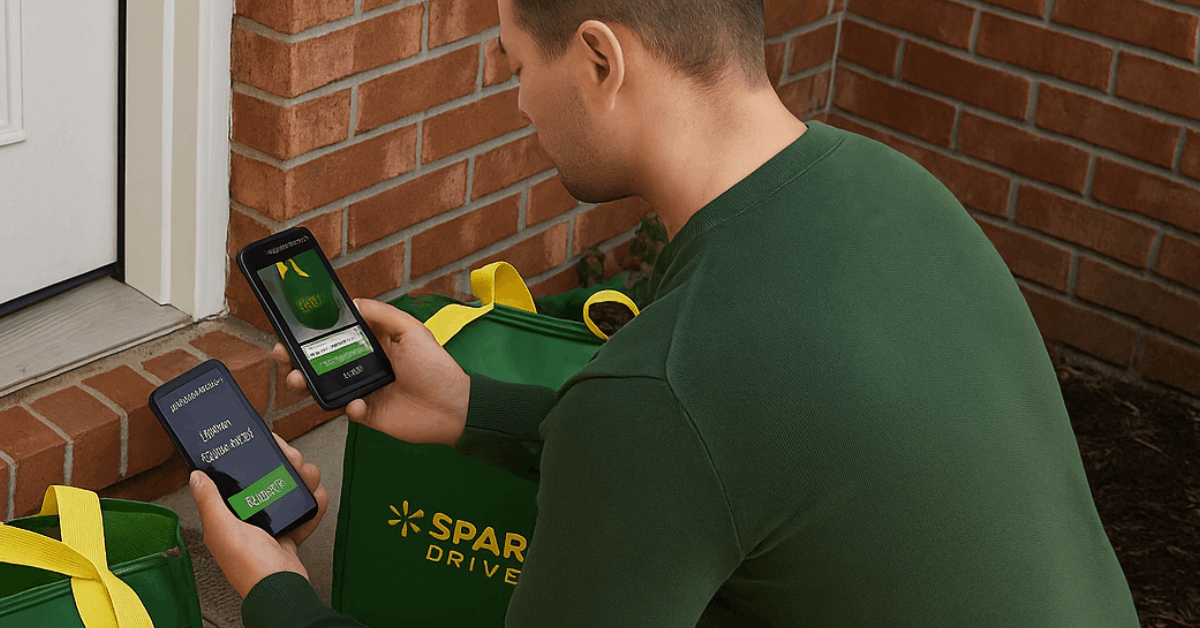
- Standard online orders: Customers order on Walmart.com or the app; drivers pick up in store and deliver to the doorstep. Contactless drop-off may be requested for convenience or health preferences.
- Shop & deliver: Drivers shop items in store and deliver to the address. Tasks take longer and require accuracy but usually pay more and may include bonuses.
Pay Snapshots: States and Cities
Location, offer timing, and tips drive variance, yet the following figures reflect commonly cited averages for the role.
Top 5 states by average annual pay:
| State (USA) | Average Pay (Year) |
| District of Columbia | $44,703 |
| California | $44,293 |
| New Jersey | $44,209 |
| Massachusetts | $43,703 |
| Alaska | $43,112 |
Top cities by average annual pay:
| City, State | Average Pay (Year) |
| San Jose, CA | $50,397 |
| Santa Clara, CA | $50,397 |
| Fremont, CA | $50,269 |
| San Francisco, CA | $50,197 |
| Daly City, CA | $50,197 |
| Oakland, CA | $48,992 |
| Berkeley, CA | $48,992 |
| Hayward, CA | $48,895 |
How Spark Earnings Actually Work
Clear expectations reduce frustration and help plan shifts more effectively.
Per-Delivery Payouts
Most runs fall in the roughly fifteen to twenty dollars range before tips, depending on order type, distance, timing, and active incentives. Each completed offer lists a guaranteed amount plus any tips that customers add.
Hourly Outcomes
Many drivers benchmark around $15.57 per hour across active time, which equals roughly $32,883 annually on an eight-hour workday assumption. Actual outcomes swing based on market demand, batching, deadhead miles, and acceptance patterns.
Annual Range
Reported totals span approximately $38,575 to $100,402 per year in the United States. Variance reflects city density, driver experience, and consistent access to high-value hours.
What Drivers Commonly Report
Real-world feedback highlights constraints and opportunities that affect day-to-day results.
Zone selection limits
Markets often restrict selectable zones despite multiple nearby stores, which can extend idle time when demand dips.
Multi-order efficiency
Batching several orders per store keeps utilization high and improves route planning across close stops, raising hourly throughput.
App reliability
Contacting customers or support occasionally requires repeated calls, which can slow resolutions for substitutions, gate codes, or reattempts.
Pros and Cons at a Glance
Trade-offs exist in every gig; weighing them upfront helps avoid surprises.
- Pros: Flexible scheduling supports part-time or full-time use without fixed shifts. Eligibility starts at age eighteen, expanding options for younger workers. Confirmed customer tips go entirely to drivers, and periodic incentives can boost busy windows.
- Cons: Low-demand periods reduce available offers in some zones. Platforms expect an acceptance rate above roughly seventy percent, limiting excessive declines. Heavy or bulky loads appear intermittently and may pay modestly relative to effort. Several drivers describe the app as less intuitive than certain competitors.
How to Apply: Steps & Requirements
Smooth onboarding cuts the wait between sign-up and first payout. Start on the Spark Driver careers page and select an operating region to preview typical driving distances and store coverage.
Core Steps
Provide contact details and consent to a background check. Choose a zone, review the job description for that area, and submit the application. After approval, set up the payment account linked to the app.
Minimum requirements:
- Age eighteen or older and able to lift up to fifty pounds
- Valid U.S. driver’s license and active auto insurance
- iPhone or Android smartphone capable of running the Spark Driver app
- Clean background check meeting program standards
Vehicle and DDI registration
Any reliable personal vehicle may be used after registering it with Delivery Drivers, Inc. (DDI).
Vehicle details should match typical order sizes for better offer assignment, and switching vehicles requires updating DDI s o store staff and customers can verify arrivals.
Spark Driver App: Quick Use Guide
A short routine keeps each run consistent and avoids preventable errors.
- Sign in and scan offers: Check store, pickup window, pay, distance, and order type before committing.
- Accept, then navigate: Head to the assigned store and follow lane or pickup instructions displayed in the app.
- Complete pickup correctly: Verify order name, count totes or bags, and confirm any cold or fragile items.
- Load and deliver: Follow the in-app route, respect customer notes, and complete contactless steps when requested.
- Close out and tip: Mark delivery complete, capture any required photos, and confirm that tips later appear in earnings.
Route Planning That Saves Time
Deadhead miles and backtracking drain hourly results quickly, so route optimization matters when handling multiple stops.
Practical upgrades
Batch nearby orders when possible, use a dedicated route planner to minimize total drive time, and enable real-time edits to handle add-on stops.
Useful features include electronic proof of delivery, CSV address import, capacity planning for trunk space, customer notifications, live re-routing, and simple integrations through APIs.
Taxes and Deductions for Spark Drivers
Independent contractor status brings extra responsibilities that directly affect net income.
Tax Status and Forms
Spark drivers operate as self-employed contractors who file federal returns using Form 1040 with Schedule C for income and expenses.
Schedule SE calculates self-employment tax, and Schedule 1 handles additional income or adjustments.
1099 Delivery and Thresholds
Earnings of at least six hundred dollars trigger a Form 1099-NEC sent by January 31 for the prior year.
Electronic delivery can be enabled in account settings. Report at least four hundred dollars of net self-employment income even when a 1099 is not issued.
Estimated Payments and Deadlines
Those expecting to owe at least one thousand dollars generally make quarterly estimated payments using Form 1040-ES.
Typical due dates are April 15, June 15, September 15, and January 15 of the following year, shifting to the next business day for weekends or federal holidays.
Penalties to Avoid
Missing the filing deadline can incur a five percent monthly penalty up to twenty-five percent of unpaid tax, while late payment adds a zero-point-five percent monthly penalty plus interest.
Filing an extension with Form 4868 extends paperwork time but not payment due dates.
Deductible Expenses
Two vehicle methods exist: the standard mileage rate ($0.67 per mile in 2024 and $0.70 in 2025) multiplied by business miles, or the actual-expense method using the business share of fuel, maintenance, insurance, depreciation, and related costs.
Other eligible expenses can include tolls and parking, phone and data plans, delivery gear, platform or payment fees, self-employed health insurance, business insurance, professional services, and pre-tax retirement contributions. Only the business portion is deductible when items serve mixed personal use.
Recordkeeping Basics
Accurate logs protect deductions during an audit.
Maintain a mileage log with date, distance, and business purpose, and retain receipts, bank statements, invoices, and notes showing the business share of each cost. The IRS generally recommends keeping tax records for at least three years.
FAQs
Short answers help lock down common questions that stall new drivers.
- What skills matter most?
Safe driving, the ability to lift up to fifty pounds, clear communication, reliable time management, solid route planning, practical app navigation, and calm problem-solving during substitutions or access issues. - How often are drivers paid?
Most drivers receive payouts weekly on Tuesdays through the Branch app to their linked bank accounts, subject to market configuration and account setup. - What does a Spark driver actually do?
Tasks include accepting offers, picking up or shopping orders at Walmart, transporting items safely, and completing doorstep or contactless delivery while following customer notes and store procedures. - How long does onboarding take?
Processing often completes within several days to a week after meeting requirements and background checks, although delays can extend longer when documents, insurance, or screening flags require follow-up.
Conclusion
Spark Driver offers flexible work, straightforward onboarding, and earnings that scale with demand and tips, allowing you to set hours and order types that align with your goals.
Prioritize peak windows, batch compatible orders, and keep tight mileage and expense records to protect your take-home at tax time.
If the requirements and pay structure fit your situation, complete the application, update your vehicle with DDI, and start accepting offers once approved.